
You’ve probably been told that digital is everything. That’s where the customers are. That’s where the future is. That’s where you need to put your money.
But here’s what most marketing advice gets wrong.
While you’re spending more and more on digital ads that get scrolled past in seconds, something interesting is happening in physical stores. 82% of purchase decisions still happen in-store. Impulse purchases alone account for 16% of all snack sales and have grown 27% since 2012.
That’s not because people are behind the times.
It’s because physical stores create something digital never can. When shoppers can see, touch, and experience products directly, their brains respond differently. The environment itself becomes part of the marketing message.
Your customers aren’t just looking at products on a screen. They’re walking through spaces that engage their senses, trigger memories, and tap into emotions in ways that change how they make decisions.
And if you’ve been wondering why your digital campaigns aren’t converting the way you hoped, this might be why.
The Psychology Behind In-Store Shopping Decisions
How Physical Environments Trigger Buying Behavior
Walk into any store and something interesting happens before you even realize it.
Your brain starts processing dozens of environmental cues. The lighting. The music. The way products are arranged. The smell in the air. Within seconds, your nervous system is making decisions about whether this space feels welcoming, trustworthy, or overwhelming.
This isn’t random. Research confirms that regardless of age, physical ads leave a more lasting impression than their digital counterparts. Your brain is wired to respond to physical environments in ways that directly influence whether you buy something.
Here’s what I find fascinating. When researchers surveyed consumers globally, 78% identified pleasant store atmosphere as a decisive factor in choosing physical retail over e-commerce. Not price. Not convenience. Atmosphere.
That tells you something important about how purchase decisions actually get made.
Physical spaces engage what researchers call sensory marketing, which aims to engage shoppers’ senses and affect their perception, judgment, and behavior. But here’s the part most people miss. It’s not just about what you see. It’s about how the entire environment makes you feel.
And here’s where it gets interesting for anyone trying to understand why their customers behave the way they do.
Shoppers spend 40% more money than planned in physical stores, compared to just 25% in online purchases. That gap exists because physical environments remove the waiting period that online shopping requires. When you have to wait for delivery, that pause disrupts the momentum of wanting something right now.
The environment influences everything. Studies show its impact on purchase quantity, time and money spent, merchandise quality evaluation, sales performance, product assessment, and store selection. Music affects how much time and money shoppers invest, while lighting influences whether they pick up and handle products.
The longer customers stay in a store, the higher their probability of making unplanned purchases. This is why grocers started adding cafés and coffee kiosks. Customers became less rushed, more relaxed, and spent more money.
It’s not manipulation. It’s understanding how people actually make decisions.
The Role of Immediate Visual Stimulation
Physical stores create something digital screens can’t replicate.
They provide continuous visual stimulus that affects real choices among products. The way products are arranged influences variety-seeking behavior. The space itself drives how people browse and select items.
Here’s what’s happening in your customers’ brains. Environmental psychology research reveals that perception of interior design and aesthetics influences how shoppers appraise objects. Colors, lighting, and materials get processed individually, but they combine to create a holistic experience.
These visual cues work differently than digital interfaces because they exist in three-dimensional space that completely surrounds shoppers.
Store displays don’t just show products. They attract attention and engage viewers through visual appeal. Well-crafted displays evoke emotions—desire, excitement, nostalgia—that influence buying decisions. They also contribute to smooth navigation, helping customers find what they need while discovering things they didn’t know they wanted.
Why Digital Ads Lack Physical Presence
Here’s the fundamental difference between physical and digital advertising.
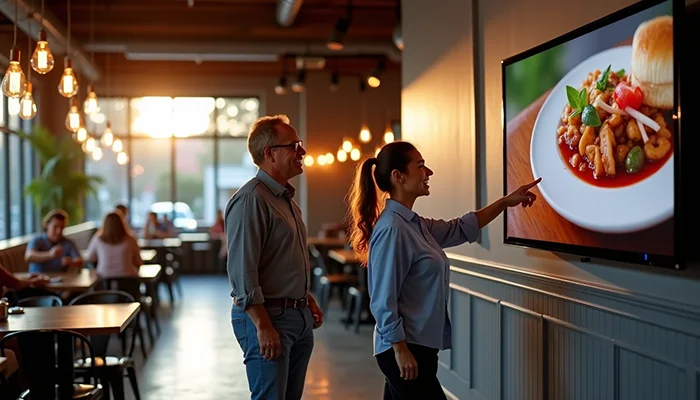
Physical advertising offers tangible presence that digital ads cannot replicate. Whether through signs, posters, or displays, physical ads occupy actual space and capture attention from people walking by. Size, color, and visual impact combine to create presence that’s hard to ignore.
Traditional marketing channels like television, print, and events create stronger emotional impact and credibility for mass audiences. People trust traditional ads more because they understand that regulations govern brand advertising in these channels. Anyone can create digital ads, which makes consumers more skeptical of brands they encounter only online.
And here’s the number that should get your attention. Ninety-five percent of digital ads get tuned out by viewers.
Physical ads maintain extended exposure. Billboards stay visible for weeks. Posters catch eyes multiple times. Displays get revisited. This sustained presence allows messages to reinforce over time in ways digital ads—consumed in seconds and forgotten immediately—simply can’t match.
Physical advertising communicates something digital cannot. It says, “We exist. We’re real. We’re invested”. You can create almost anything online, but tangible presence requires genuine investment.
When shoppers connect with physical advertising, marketing stops feeling like promotion and starts feeling like a relationship.
Memory Formation and Brand Recall in Physical Stores
How Attention Drives Memory in Shopping Contexts
Here’s something that might surprise you about how your brain actually works.
Diana Tamir’s research found that when you attend a concert and use your phone to film or take pictures, your memory for the event becomes substantially worse than if you had simply experienced it directly. You’re essentially outsourcing your attention to a device instead of fully experiencing the moment.
This applies directly to how people shop.
When shoppers have to work slightly harder to process information, that extra effort creates stronger neural pathways. Research demonstrates that messages written in fonts that are slightly difficult to read get remembered much better than easily readable text. The mental work required to decode the information paradoxically makes it stick.
Most people don’t realize how selective their attention really is when shopping. Studies show that shoppers filter available alternatives using relatively simple criteria before getting into detailed analysis. Most people consider far fewer products than the total number available—usually just 3 to 6 items.
This filtering happens because processing every option would overwhelm your brain’s attention resources. Brands that capture initial attention enter what researchers call the “consideration set,” where the real evaluation happens.
Cereal packaging research using eye-tracking and EEG technology uncovered something fascinating about involuntary visual attention. Packaging that drew attention without any instruction to focus got remembered later. Participants showed better memory for packages that automatically captured their gaze.
Your brain is constantly deciding what’s worth remembering. And physical environments give it a lot more to work with.
The Generation Effect in Marketing
Norman Slamecka and Peter Graf discovered something important about human memory in 1978. They found that students who generated words themselves were 15% more likely to remember them compared with participants who simply read complete words.
In 2020, researchers tested this with 415 people using brand names. The results showed a 14% improvement in memorability when people had to figure out answers themselves. The finding held consistent across decades and different groups, revealing something fundamental about how memory works.
Mattress brand Casper applied this principle in a subway campaign featuring word puzzles. Commuters had to strain their attention to figure out what the puzzles spelled. This additional mental work, known as the Generation Effect, helps advertisements stick in memory.
The #MissingType campaign by NHS Blood and Transplant removed letters A, B, and O from logos and headlines to highlight blood donation needs. The best ads make you work slightly. You feel clever for solving them and want to discuss them with others.
The skill is balancing puzzle difficulty with enough stopping power to get people to pause and think.
Physical stores can create these moments in ways digital never can. When shoppers have to navigate spaces, examine products, and make choices in real-time, their brains are constantly engaged in this kind of active processing.
Why Store Experiences Create Lasting Impressions
Memory is fundamentally a physical process. For new experiences to leave impressions, they have to actually change your brain.
Physical retail spaces offer something digital can’t—immersive experiences that create deeper emotional connections between brands and consumers. A well-designed store evokes emotions and offers multi-sensory interaction that simply cannot be replicated online.
Here’s the key: emotional experiences drive stronger memory formation. Research shows that emotionally-charged experiences have a 20% higher recall rate than neutral experiences. When people engage emotionally through joy, nostalgia, or even mild surprise, brand recall increases exponentially.
A consistent multi-sensory brand environment can increase brand recall by 70%. Physical stores let retailers immerse customers in brand culture in ways that create lasting impressions. Customers experience the distinct feeling of a brand by moving through branded space.
This creates stronger customer-brand relationships and higher likelihood of repeat business.
The peak-end rule explains why this matters so much. People tend to remember and judge experiences based on how they felt during the most intense moments and when interactions concluded. Brands that attach themselves to these milestone moments establish permanent mental bookmarks.
Physical stores create these memorable touchpoints because they engage multiple senses simultaneously, triggering stronger memory encoding than digital interactions ever could.
Sensory Store Psychology: Engaging Multiple Senses
Walk into a well-designed store and something happens that you might not even notice.
Your body relaxes slightly. Your pace slows down. You start to browse instead of just shopping.
That’s not an accident.
Visual Elements and Product Placement
Sight accounts for 83% of the information we receive. But here’s what most retailers get wrong about visual merchandising. They think it’s just about making things look pretty.
It’s not. It’s about understanding how your customers’ brains actually work.
“Eye level is buy level” isn’t just a catchy phrase. Products placed at eye level correlate directly with sales performance. Put something above eye level, and it becomes harder to see or reach. Below eye level, and you’re asking customers to bend or crouch. Most people won’t.
Retailers spend enormous amounts figuring out the psychology of shelf placement. Block placement groups related categories together. Vertical placement guides eyes up and down from eye-level anchor points. Horizontal placement pulls shoppers further into stores.
Your customers read shelves the same way they read a page. Left to right, top to bottom. Once you understand that pattern, product placement starts to make a lot more sense.
The Impact of Store Atmosphere on Purchasing
Store atmosphere isn’t just about creating a pleasant environment. It’s about triggering specific behavioral responses.
Studies show that atmospheric factors have a significant positive correlation with customer approach behaviors. But here’s the interesting part. The intangible factors have the most significant impact. Temperature, music, lighting. The style and layout. Even the other customers and employees in the space.
These elements work together to influence not just how customers feel, but how they perceive the products and services you’re offering.
When the atmosphere feels right, customers stay longer. They explore more. They become more receptive to making purchases they hadn’t planned.
When it feels wrong, they leave. Even if they came in looking for something specific.
Touch, Sound, and Smell in Shopper Behavior
Our sense of sound never turns off. Even when we’re sleeping.
That’s why 72.6% of shoppers notice background music at grocery stores. When people hear music they like, their bodies release dopamine, which makes them more inclined to buy. Fast music creates energy and urgency. Slow music makes people relax and browse longer.
But sound is just one piece.
Touch provides information that photos and descriptions can’t. This is why Apple built nearly 500 stores worldwide where customers can use, feel, and try products before buying. That tactile interaction helps people evaluate quality and functionality simultaneously. Touch contributes 25% to brand building efforts.
Then there’s smell. It connects directly to the part of your brain that regulates emotions and memories. This makes smell the sense with the highest memory recall, with 75% of emotions tied to scent-based memories.
Rolls Royce perfumes their car interiors with wood and leather scents during service visits. Disney uses their patented Smellitzer scent generator throughout their parks.
These aren’t random choices. They’re calculated decisions to create emotional connections that last long after the purchase.
Creating Multisensory Brand Experiences
Here’s what makes physical stores so powerful. All these sensory elements don’t work alone. They work together.
A consistent multisensory brand environment can increase brand recall by 70%.
The best sensory marketing guides customers toward certain choices without them realizing what influenced their decisions. Physical stores differentiate from online competitors precisely because of this multisensory nature that digital can’t replicate.
This is why, despite predictions that physical retail was dying, we’re seeing what researchers call Marketing 5.0 – the renaissance of brick-and-mortar stores.
Smart retailers understand that when you engage multiple senses simultaneously, you’re not just selling products. You’re creating experiences that stick with people long after they leave your store.
And that’s something a digital ad will never be able to do.
Emotional Drivers of Purchase Decisions
Here’s the thing about shopping decisions. They’re not nearly as logical as we pretend they are.
Marketers spend about $60 billion annually in the U.S. on in-store merchandising and shopper marketing, with increases of 8% to 10% every year since 2008. That’s not because they’re throwing money at pretty displays for fun.
It’s because emotions drive 70% of consumer decisions. And physical displays trigger emotional responses in ways that digital ads simply can’t match.
Why In-Store Displays Actually Work
More than one in six in-store brand purchases occur when the brand is displayed. Half of consumers recalled seeing at least one display during their shopping trip, with floor stands and endcap displays dominating recall at 86%.
But here’s what’s really happening underneath those numbers.
Your brain processes emotional information faster than logical information. When you see a well-designed display, your emotional response kicks in before your rational mind has time to evaluate whether you actually need the product.
Store layouts and visual merchandising create specific atmospheres through color, lighting, and design elements that directly influence how you feel. And how you feel determines whether you buy.
It’s not manipulation. It’s just how human brains work.
The Impulse Purchase Reality
Let’s be honest about impulse buying. It happens because physical stores stimulate all five senses simultaneously.
When you’re shopping online, there’s a built-in pause. You add something to your cart, maybe you think about it, maybe you get distracted. The moment passes.
But in a physical store? There’s no waiting period. You see it, you feel it, you want it, you buy it.
Research confirms that 40% of consumers spend more money than planned in physical stores compared to 25% in online purchases. That gap exists because immediate gratification beats delayed gratification almost every time.
When you experience positive emotions like happiness or excitement, your brain releases dopamine. You become more receptive to persuasive communication and more likely to say yes to purchases you hadn’t planned on making.
Different emotions create entirely different buying patterns. Nostalgia makes people significantly less sensitive to price. Fear of missing out triggers rapid purchasing that bypasses logical evaluation. Pride drives luxury purchases by providing dopamine boosts associated with elevated status.
Your emotional state in that moment determines what you buy and how much you’re willing to spend.
Building Connection Through Physical Experience
Customers who feel genuinely connected to a brand deliver more value by purchasing products more often and providing higher recommendations.
Physical retail spaces create these connections through immersive experiences that forge deeper emotional bonds between brands and consumers. When you can touch, try, and experience products directly, you’re not just evaluating features and benefits. You’re creating memories and associations.
These sensory-charged environments allow stores to offer more than utilitarian shopping trips. They become emotionally engaging experiences. Consumers generally prefer experiences over products and show willingness to pay more when experiences make them feel joy and nostalgia.
Consumers are up to 1.5 times more likely to favor brands they perceive as aligned with their personal beliefs. Physical stores provide the perfect environment for brands to demonstrate those values through customer service, store design, and the overall experience they create.
When customers feel emotionally connected to a brand, they become repeat customers and recommend the brand to others.
And that emotional connection happens most powerfully when you can experience the brand with all your senses, not just see it on a screen.
Consumer Behavior: The Psychology of Marketing in Action
Decision-Making at the Point of Purchase
Here’s something that might surprise you about how people actually buy.
Most marketing advice treats purchase decisions like they’re split between logical and emotional buyers. The logical ones who compare features and prices. The emotional ones who buy on impulse.
But consumer surveys reveal something different: 20% of purchase decisions are logical and 80% are emotional. Even the “logical” buyers aren’t as logical as they think. People rationalize buying decisions based on facts, but they make those decisions based on feelings.
This isn’t a flaw in human thinking. It’s how our brains actually work.
Recent studies analyzing over 2,000 consumers found that 86% of buying choices were shaped by emotional needs, with an average of 10 distinct emotional needs influencing each purchase. These needs range from wanting to feel good about themselves to caring about how others perceive them.
The decision happens first. The justification comes after.
The Analytical Shopper Psychology vs. Emotional Buyer
There are shoppers who genuinely focus on practical considerations. They analyze costs, compare product features, read reviews, and prioritize functionality. You’ll see this especially with electronics, appliances, or financial services.
But here’s where it gets interesting.
Even these analytical shoppers aren’t immune to emotional influence. They just experience it differently. The satisfaction of making a “smart” choice. The confidence that comes from thorough research. The pride of finding the best deal.
Those are emotional responses too.
Emotional purchases account for 95% of all buying decisions. Fashion, travel, and food purchases obviously trigger emotional responses. But the decision-making process isn’t strictly rational or emotional. Customers evaluate rational aspects first, then emotional factors influence the final choice.
It’s more like emotion provides the energy to act on the logical evaluation.
Brand Awareness Through Repeated Store Exposure
Here’s what most brands get wrong about building awareness.
They assume one great interaction will create lasting memory. But customers rarely act on a brand message after just one exposure. Marketing research consistently shows that 5-7 interactions are needed before a consumer remembers a brand.
Physical stores give you those repeated interactions naturally.
Every time someone walks past your display, that’s another touch point. Every time they see your product on the shelf, that’s building familiarity. The mere exposure effect demonstrates that humans favor what’s familiar. Seeing a brand repeatedly breeds familiarity, which subconsciously builds trust.
Marketing studies confirm that showing an ad 5-9 times can improve brand awareness metrics by up to 51% compared to a single exposure. Physical retail gives you this repetition without having to pay for each impression.
How In-Store Ads Influence Brand Loyalty
Store brands show considerably higher purchase loyalty than you’d expect, especially when they account for large shares of category sales. Physical advertising captures attention when shoppers are ready to buy, not when they’re scrolling through social media thinking about something else.
The timing matters more than you might think.
When someone is already in shopping mode, walking through aisles with a cart or basket, their brain is primed for purchase decisions. In-store ads work because they meet customers where they are, both physically and mentally.
Over time, this repeated exposure creates sustained visibility that turns casual shoppers into loyal customers. It’s not just about the ad itself. It’s about being consistently present when purchase decisions happen.
And that presence builds something digital advertising struggles to create: trust that comes from being real, being there, and being consistent.
Measuring the Effectiveness of In-Store Advertising
Purchase Intent vs. Actual Buying Behavior
Here’s the problem with how most agencies measure success.
They ask people what they plan to buy. Then they assume that’s what actually happens.
But here’s what the numbers actually show. When researchers examined two cereal products, the first showed 31% of people saying they’d definitely buy it. Only 0.8% actually did. The second product? Just 21% claimed intent, but 6.0% actually purchased.
People are terrible predictors of their own behavior.
I see this disconnect all the time. Marketing teams celebrate high intent scores, then wonder why sales don’t follow. The gap is real, and it’s bigger than most people think.
The reason agencies keep using purchase intent is simple. It’s easy data to collect. But easy doesn’t mean accurate.
There is one interesting twist, though. Answering a purchase intention question makes consumers more likely to remember their original intentions and follow through. So the very act of asking changes the outcome by 58% compared to people who weren’t surveyed.
Conversion Rates: Digital vs. Physical
Digital conversion rates sit around 2% to 5%. That’s considered normal. Expected, even.
But when Google and Wolfgang Digital looked at what actually happens, they found something interesting. Digital marketers saw an extra 168% in revenue through in-store sales on top of their online results.
That means for every dollar you think your digital ads are generating, they’re actually generating $2.68 when you account for the in-store impact you’re not tracking.
Most marketers are measuring half the story.
Brand Recall Metrics in Retail Environments
Brand recall gets measured by asking people to name brands they remember, then calculating the percentage who got yours right.
Simple enough.
But speed matters more than most people realize. How quickly someone recalls your brand connects directly to purchase likelihood. The faster they think of you, the more likely they are to buy.
The real value comes from measuring before and after campaigns. That’s how you see the actual lift your marketing created, rather than just hoping correlation equals causation.
Because when you’re spending money on advertising, you want to know it’s actually working.
Not just that people say it might.
What This Means for Your Business
Here’s what the research tells us.
Physical stores aren’t going anywhere. They’re not old-fashioned or outdated. They’re doing something your digital ads can’t do.
They’re creating experiences that stick. They’re building trust through presence. They’re tapping into how people actually make decisions.
And while everyone else is chasing the next digital trend, the brands that understand this are quietly building deeper connections with their customers.
Your in-store advertising isn’t just supporting your digital efforts.
It might be doing the heavy lifting.
The Path Forward
This doesn’t mean you abandon digital marketing. It means you stop treating physical retail like an afterthought.
When customers can see, touch, and experience your brand in person, something changes. They remember you differently. They trust you more. They buy more often.
The brands that get this right aren’t choosing between digital and physical. They’re using both, but they understand which one actually drives decisions.
Because when it comes to making sales, being there still matters more than being seen.
Key Takeaways
Understanding shopper psychology reveals why physical retail environments consistently outperform digital advertising in driving actual purchases and building lasting brand connections.
• Physical stores drive 82% of purchase decisions through multisensory experiences that digital ads cannot replicate, with shoppers spending 40% more than planned in-store versus 25% online.
• Emotional triggers dominate buying behavior – 95% of purchase decisions are emotional, with positive emotions like joy and nostalgia making customers significantly less price-sensitive.
• The Generation Effect boosts memory by 14% when customers actively engage with in-store displays, creating stronger brand recall than passive digital consumption.
• Multisensory engagement increases brand recall by 70% as physical environments stimulate sight, sound, touch, and smell simultaneously to forge deeper emotional connections.
• Trust builds through tangible presence – physical advertising demonstrates genuine investment and credibility while 95% of digital ads get tuned out by viewers.
The psychology of marketing works fundamentally differently in physical spaces, where immediate sensory feedback, emotional engagement, and the ability to touch and experience products create purchase momentum that digital channels struggle to match.